Software Engineer Portfolio
Parallel Integration Engine
Last Updated: August 3, 2026
Tech Stack
- RustAPI & workers
- PostgreSQLJobs & local queue
- AWS SQSCloud queue
The Parallel Integration Engine, or PIE for short, is a distributed mathematical computing platform built entirely in Rust. It lets users submit computationally intensive math problems without waiting for them to finish in the foreground.
Each request becomes a job that is placed in a queue, processed asynchronously by available workers, and tracked from submission through completion.
Calculations
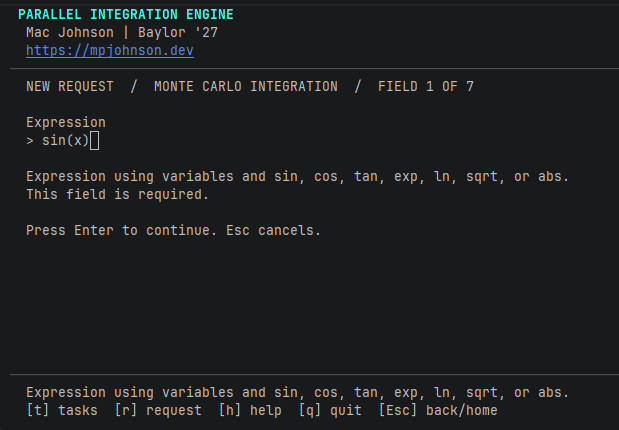
The platform supports custom, multidimensional integral approximations using Monte Carlo simulations, as well as π estimations using the same approach. For integral jobs, users can input a custom expression, including multiple variables, bounds, and built-in math functions like exponentials or trig operations.
Large integral calculations are divided into independent pieces and distributed across multiple workers. When the calculations are complete, the app reports the estimate, standard error, and an approximate 95% confidence interval.
Command-Line Interface
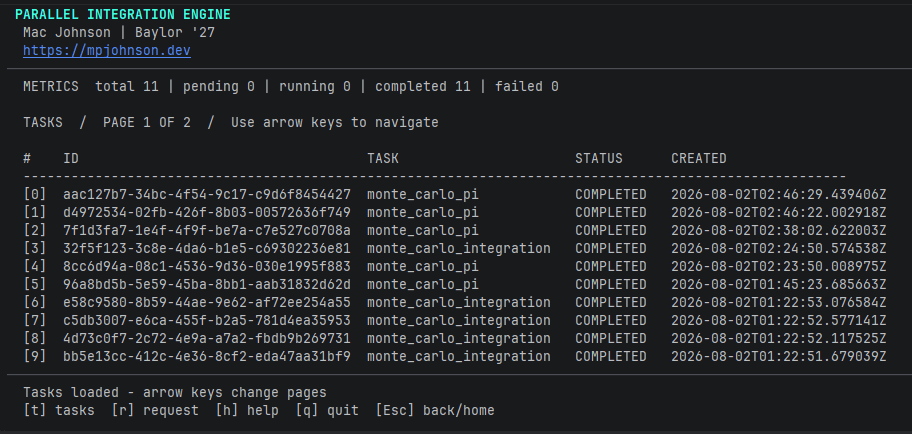
Users interact with the platform through a keyboard-driven terminal interface. From there, they can submit new calculations, browse recent jobs, inspect detailed results, monitor partition-level progress, and view metrics such as pending, running, completed, and failed jobs.
I considered creating a graphical user interface in React; however, a command-line interface in the terminal is sometimes a more elegant solution.
Task Distribution
Behind the interface is a production-style distributed architecture. A Rust API accepts requests and records them in PostgreSQL, while a configurable job queue delivers work to asynchronous Rust workers. The workers execute jobs concurrently, record results, retry failures, and can route repeatedly failing jobs to a dead-letter queue. Seeded, global-index sampling also makes distributed calculations reproducible even when partitions run in a different order or need to be retried.
The job queue is configurable to be either a local PostgreSQL instance or an AWS SQS instance in the cloud. When AWS SQS is used, poisoned tasks will be delivered to a DLQ to prevent them from disrupting the task flow.
Purpose Statement
I built this app because I wanted to deepen my skills in Rust and learn more about cloud technologies like AWS. I also wanted to draw on my math background and develop something that integrates (pun intended) something that interests me, like Monte Carlo simulations and estimated risk. Feel free to check out PIE for yourself and reach out if you have any questions.
QED.